

Close Menu

    Subscribe to Updates

    Get the latest creative news from FooBar about art, design and business.

    What's Hot

    Donald Trump serves fries at McDonald’s five days after flop crypto launch

    May 14, 2026

    Aave CEO says Clarity Act could reshape DeFi regulation — but BTC at ~$80K keeps macro pressure in focus?

    May 14, 2026

    Uniswap Labs launches Unichain without UNI unanimity

    May 14, 2026
    Facebook X (Twitter) Instagram
    Ai Crypto TimesAi Crypto Times
    • Altcoins
      • Bitcoin
      • Coinbase
      • Litecoin
    • Blockchain
    • Crypto
    • Ethereum
    • Lithosphere News Releases
    X (Twitter) Instagram YouTube LinkedIn
    Ai Crypto TimesAi Crypto Times
    Home » Validated, staking on eth2: #5 – Why client diversity matters

    Validated, staking on eth2: #5 – Why client diversity matters

    Michael JohnsonBy Michael JohnsonMarch 24, 2026No Comments5 Mins Read
    Facebook Twitter Pinterest LinkedIn Tumblr Reddit Telegram Email
    Share
    Facebook Twitter LinkedIn Pinterest Email


    *Disclaimer: None of this is meant as a slight against any client in particular. There is a high likelihood that each client and possibly even the specification has its own oversights and bugs. Eth2 is a complicated protocol, and the people implementing it are only human. The point of this article is to highlight how and why the risks are mitigated.*

    With the launch of the Medalla testnet, people were encouraged to experiment with different clients. And right from genesis, we saw why: Nimbus and Lodestar nodes were unable to cope with the workload of a full testnet and got stuck. [0][1] As a result, Medalla failed to finalise for the first half hour of its existence.

    On the 14th of August, Prysm nodes lost track of time when one of the time servers they were using as a reference suddenly jumped one day into the future. These nodes then started making blocks and attestations as though they were also in the future. When the clocks on these nodes were corrected (either by updating the client, or because the timeserver returned to the correct time), those that had disabled the default slashing protection found their stakes slashed.

    Exactly what happened is a bit more subtle, I highly recommend reading Raul Jordan’s write-up of the incident.

    Clock Failure – The enworsening

    The moment when Prysm nodes started time traveling, they made up ~62% of the network. This meant that the threshold for finalising blocks (>2/3 on one chain) could not be met. Worse still, these nodes couldn’t find the chain that they were expecting (there was a 4 hour “gap” in the history and they all jumped ahead to slightly different times) and so they flooded the network with short forks as they guessed at the “missing” data.
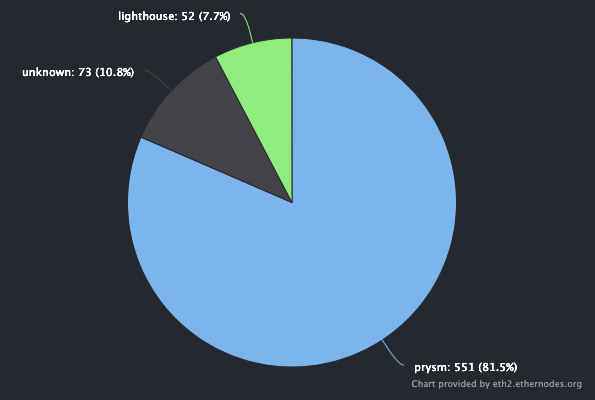

    Prysm currently makes up 82% of Medalla nodes 😳 ! [ethernodes.org]

    At this point, the network was flooded with thousands of different guesses at what the head of the chain was and all the clients started to buckle under the increased workload of figuring out which chain was the right one. This led to nodes falling behind, needing to sync, running out of memory, and other forms of chaos, all of which worsened the problem.

    Ultimately this was a good thing, as it allowed us to not only fix the root problem relating to clocks, but to stress test the clients under condition of mass node failure and network load. That said, this failure need not have been so extreme, and the culprit in this case was Prysm’s dominance.

    Shilling Decentralisation – Part I, it’s good for eth2

    As I’ve discussed previously, 1/3 is the magic number when it comes to safe, asynchronous BFT algorithms. If more than 1/3 of validators are offline, epochs can no longer be finalised. So while the chain still grows, it is no longer possible to point to a block and guarantee that it will remain a part of the canonical chain.

    Shilling Decentralisation – Part II, it’s good for you

    To the maximum possible extent, validators are incentived to do what is good for the network and not simply trusted to do something because it is the right thing to do.

    If more than 1/3 of nodes are offline, then penalties for the offline nodes start ramping up. This is called the inactivity penalty.

    This means that, as a validator, you want to try to ensure that if something is going to take your node offline, it is unlikely to take many other nodes offline at the same time.

    The same goes for being slashed. While, there’s always a chance that your validators are slashed due to a spec or software mistake/bug, the penalties for single slashings are “only” 1 ETH.

    However, if many validators are slashed at the same time as you, then penalties go up to as high as 32 ETH. The point at which this happens is again the magic 1/3 threshold. [An explanation of why this is the case can be found here].

    These incentives are called liveness anti-correlation and safety anti-correlation respectively, and are very intentional aspects of eth2’s design. Anti-correlation mechanisms incentivise validators to make decisions that are in the best interest of the network, by tying individual penalties to how much each validator is impacting the network.

    Shilling Decentralisation – Part III, the numbers

    Eth2 is being implemented by many independent teams, each developing independent clients according to the specification written primarily by the eth2 research team. This ensures that there are multiple beacon node & validator client implementations, each making different decisions about the technology, languages, optimisations, trade-offs etc required to build an eth2 client. This way, a bug in any layer of the system will only impact those running a specific client, and not the whole network.

    If, in the example of the Prysm Medalla time-bug, only 20% of eth2 nodes were running Prysm and 85% of people were online, then the inactivity penalty wouldn’t have kicked in for Prysm nodes and the problem could have been fixed with only minor penalties and some sleepless nights for the devs.

    In contrast, because so many people were running the same client (many of whom had disabled slashing protection), somewhere between 3500 and 5000 validators were slashed in a short period of time.* The high degree of correlation means that slashings were ~16 ETH for these validators because they were using a popular client.

    * At the time of writing, slashings are still pouring in, so there is no final number yet.

    Try something new
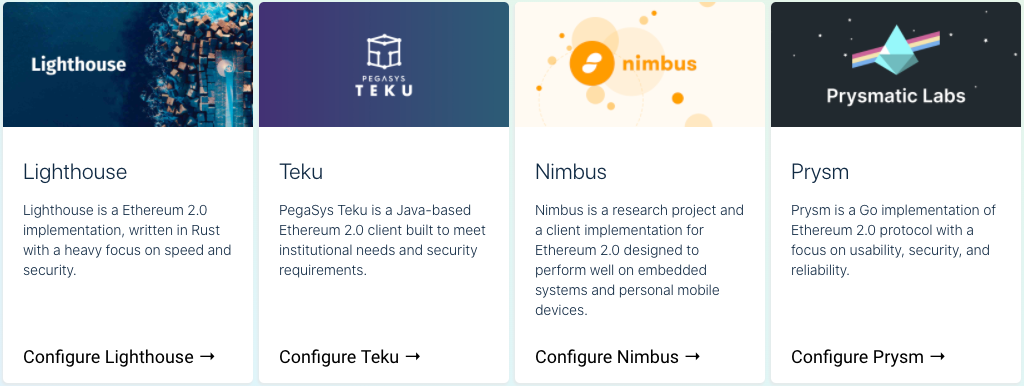
    Now is the time to experiment with different clients. Find a client that a minority of validators are using, (you can look at the distribution here). Lighthouse, Teku, Nimbus, and Prysm are all reasonably stable at the moment while Lodestar is catching up fast.

    Most importantly, TRY A NEW CLIENT! We have an opportunity to create a more healthy distribution on Medalla in preparation for a decentralised mainnet.


    Source link

    Share. Facebook Twitter Pinterest LinkedIn Tumblr Email
    Michael Johnson

    Related Posts

    Clear Signing: Making Transaction Approvals Safer on Ethereum

    May 12, 2026

    Protocol Cluster Updates: May 2026

    May 11, 2026

    Soldøgn Interop Recap ☀️ | Ethereum Foundation Blog

    May 2, 2026

    Comments are closed.

    Don't Miss

    Donald Trump serves fries at McDonald’s five days after flop crypto launch

    Coinbase May 14, 2026

    Five days after the disappointing launch of Donald Trump’s World Liberty Financial, he was filmed…

    Aave CEO says Clarity Act could reshape DeFi regulation — but BTC at ~$80K keeps macro pressure in focus?

    May 14, 2026

    Uniswap Labs launches Unichain without UNI unanimity

    May 14, 2026

    Copper gold ratio repeats Bitcoin’s 2020 signal

    May 14, 2026
    Stay In Touch
    • Facebook
    • Twitter
    • Pinterest
    • Instagram
    • YouTube
    • Vimeo
    Our Picks

    This feed has expired. Please contact us for pricing options.

    May 5, 2026

    AGII Introduces Scalable AI Execution Layer for Decentralized Systems

    May 1, 2026

    Lithosphere Deploys Full-Stack Development Environment for AI-Native Applications

    May 1, 2026

    Lithosphere Integrates AI Mock Providers for Continuous Integration Workflows

    April 30, 2026

    Subscribe to Updates

    Get the latest creative news from SmartMag about art & design.

    Demo
    • Popular
    • Recent
    • Top Reviews

    Colle AI Positions Intelligent Design as the Future of NFT Creation

    March 14, 2026

    ICP price retests key level: what’s the outlook?

    March 14, 2026

    Treasury Staking Initiative | Ethereum Foundation Blog

    March 14, 2026

    Donald Trump serves fries at McDonald’s five days after flop crypto launch

    May 14, 2026

    Aave CEO says Clarity Act could reshape DeFi regulation — but BTC at ~$80K keeps macro pressure in focus?

    May 14, 2026

    Uniswap Labs launches Unichain without UNI unanimity

    May 14, 2026
    Latest Galleries
    [latest_gallery cat="all" number="5" type="slider"]
    Latest Reviews
    Demo
    Top Posts

    This feed has expired. Please contact us for pricing options.

    May 5, 20263 Views

    Lithosphere Deploys Full-Stack Development Environment for AI-Native Applications

    May 1, 20262 Views

    Lithosphere Integrates AI Mock Providers for Continuous Integration Workflows

    April 30, 20262 Views

    Lithic Introduces zk-Verifiable AI Execution Standard (LEP100-5)

    March 17, 20262 Views
    Don't Miss

    Donald Trump serves fries at McDonald’s five days after flop crypto launch

    Coinbase May 14, 2026

    Five days after the disappointing launch of Donald Trump’s World Liberty Financial, he was filmed…

    Aave CEO says Clarity Act could reshape DeFi regulation — but BTC at ~$80K keeps macro pressure in focus?

    May 14, 2026

    Uniswap Labs launches Unichain without UNI unanimity

    May 14, 2026

    Copper gold ratio repeats Bitcoin’s 2020 signal

    May 14, 2026
    Stay In Touch
    • Facebook
    • Twitter
    • Pinterest
    • Instagram
    • YouTube
    • Vimeo

    Subscribe to Updates

    Get the latest creative news from SmartMag about art & design.

    Demo
    Top Posts

    Xiaomi rolls out MiMo V2.5 with multimodal AI and improved efficiency

    April 23, 202614 Views

    Meta’s Muse Spark ends its open-source AI era

    May 9, 202611 Views

    Pi Network confirms Consensus 2026 sponsorship

    May 2, 20268 Views

    Anthropic revenue just hit a $30 billion run rate

    April 9, 20268 Views
    Don't Miss

    Donald Trump serves fries at McDonald’s five days after flop crypto launch

    Coinbase May 14, 2026

    Five days after the disappointing launch of Donald Trump’s World Liberty Financial, he was filmed…

    Aave CEO says Clarity Act could reshape DeFi regulation — but BTC at ~$80K keeps macro pressure in focus?

    May 14, 2026

    Uniswap Labs launches Unichain without UNI unanimity

    May 14, 2026

    Copper gold ratio repeats Bitcoin’s 2020 signal

    May 14, 2026
    Stay In Touch
    • Facebook
    • Twitter
    • Pinterest
    • Instagram
    • YouTube
    • Vimeo

    Subscribe to Updates

    Get the latest creative news from SmartMag about art & design.

    X (Twitter) Instagram YouTube LinkedIn
    Our Picks

    Donald Trump serves fries at McDonald’s five days after flop crypto launch

    May 14, 2026

    Aave CEO says Clarity Act could reshape DeFi regulation — but BTC at ~$80K keeps macro pressure in focus?

    May 14, 2026

    Uniswap Labs launches Unichain without UNI unanimity

    May 14, 2026
    Recent Posts
    • Donald Trump serves fries at McDonald’s five days after flop crypto launch
    • Aave CEO says Clarity Act could reshape DeFi regulation — but BTC at ~$80K keeps macro pressure in focus?
    • Uniswap Labs launches Unichain without UNI unanimity
    • Copper gold ratio repeats Bitcoin’s 2020 signal
    • Sony’s blockchain venture Soneium has a phishing scam issue
    © 2026 - 2026

    Type above and press Enter to search. Press Esc to cancel.