



The prop trading industry has exploded in popularity, attracting hundreds of thousands of retail traders with promises of funded accounts, generous profit splits, and low barriers to entry. But beneath the polished marketing lies a web of fees that the industry rarely advertises upfront. Understanding these hidden costs is not just smart — it is essential to surviving and thriving in the prop trading ecosystem.
This analytical overview breaks down every major category of Hidden Fees in Prop Trading Firms you are likely to encounter, backed by verified industry data, and gives you the tools to make better decisions before signing up with any prop firm.
How to Calculate the True Cost Before Your First Payout

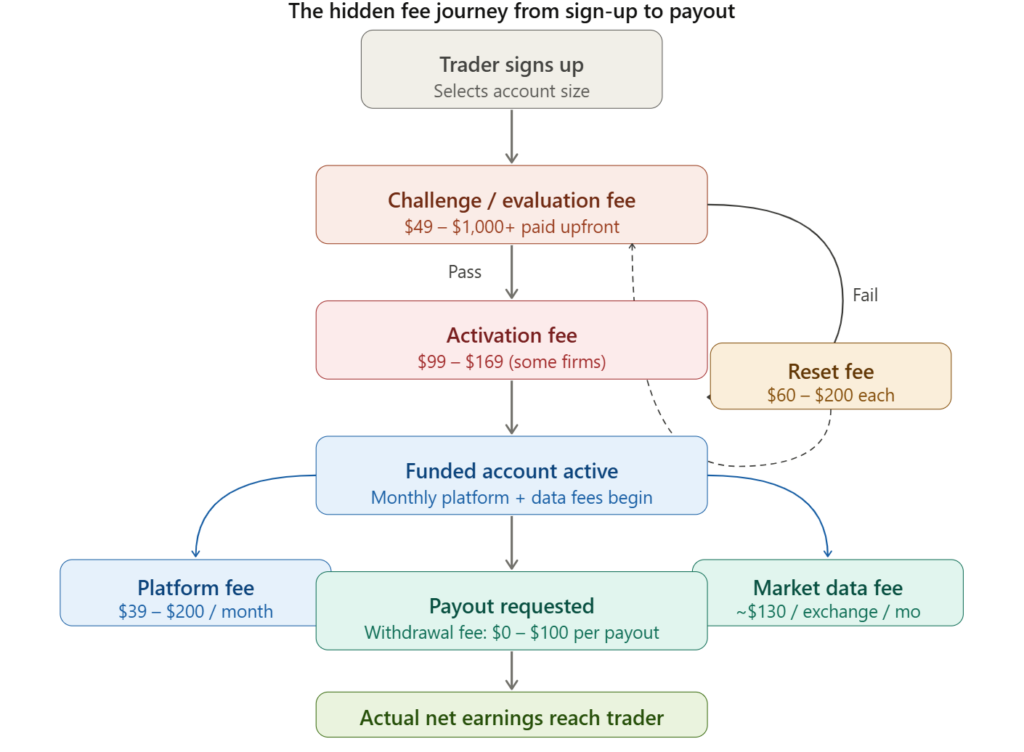
The biggest pricing mistake prop traders make is comparing firms by headline challenge fee alone. That number is often only the first layer of cost. A more accurate comparison is the total cash you may spend before your first successful withdrawal. In practical terms, that means adding together the evaluation cost, any activation charge after passing, recurring platform or market-data fees, and any payout processing charge that appears when you finally request profits.
A firm with a lower advertised entry price can end up being more expensive than a higher-priced competitor once those additional layers are included. Topstep is a good example of why this matters. Its Standard Trading Combine path may look cheaper at the start, but after passing, traders may still face a one-time activation fee for the funded account path depending on the plan selected.

Topstep also charges extra for Level 2 Depth of Market data, and payout processing charges can apply when traders request profits. That means the real cost of moving from evaluation to funded trading to actual cash in hand can be materially higher than the initial subscription suggests.
By contrast, some firms reduce friction by removing one of these extra layers. Tradeify states that certain account types do not carry activation fees after passing. That does not automatically make Tradeify cheap, but it does make the post-pass transition cleaner because the trader is not hit with an additional funded-account activation bill after meeting the evaluation target.
Apex Trader Funding offers another example of why traders should check post-pass costs carefully. After passing, traders must complete the PA activation process within the stated deadline, and this includes a one-time activation fee. This again reinforces the same point: a trader should never stop the cost calculation at the evaluation checkout page.
The cleanest way to compare firms is to use a simple formula:
True Cost Before First Payout = Evaluation Fee + Activation Fee + Recurring Platform/Data Costs + Reset Costs + Payout Processing Charges
This formula matters because each component changes trader economics in a different way. Activation fees increase the price of success. Monthly platform or data charges penalize traders who need more time. Reset fees compound the cost of failure. Payout charges reduce the cash value of profits already earned. A prop firm that looks cheap at sign-up can therefore become expensive by the time a trader actually reaches the first withdrawal.
For readers, the practical rule is simple: never ask only, “What does the challenge cost?” Ask, “What will I spend before I receive my first payout?” That is the number that reveals whether a prop firm is genuinely trader-friendly or simply marketed well.
Also, you may read Crypto Prop Firms vs futures prop firms
Quick Comparison Checklist
Before signing up, verify these five points on the firm’s official site:
- Is there an activation fee after passing?
- Is billing one-time or monthly recurring?
- Are market-data or platform fees extra?
- Does the firm charge for payouts?
- What is the total likely cost before first withdrawal?
Also, you may read 5 Best Forex Prop Firms With Fastest Payouts
1. The Challenge / Evaluation Fee: The Starting Point
The first fee every prop trader encounters is the challenge or evaluation fee — the cost to participate in an evaluation process that determines whether you qualify for funded capital. On the surface, this fee seems reasonable. In practice, it is the foundation of a revenue model that, in many firms, depends on you failing.
Challenge fees across the industry typically range from $49 to over $1,000, depending on the account size and evaluation format. A standard two-step challenge for a $100,000 account at most mid-tier firms costs between $300 and $600. The issue is not the fee itself — it is the ecosystem built around it.
Subscription-based challenge models are particularly costly for traders who take time to pass. At monthly rates of $90–$175, a trader who takes three months to complete a challenge can pay three to five times more than the same challenge offered on a one-time payment basis. Most traders take two to four months to pass, making one-time payment firms significantly cheaper in practice.
Also, you may read Prop Firms With the Lowest Challenge Fees
2. Activation Fees: Paying Twice to Trade
One of the most criticized hidden charges in the prop trading world is the activation fee — a cost that traders must pay after successfully passing a challenge, before they can access their funded account. In effect, it means paying twice: once to prove your skill, and once to actually use the capital you’ve earned.
Examples: Apex Trader Funding charges $99, while Bulenox charges $148 as activation fees after challenge completion.
From a structural standpoint, activation fees are indefensible when framed as trader support. Firms that charge them are essentially installing an additional revenue gate between a successful trader and their funded account. Transparent firms like Phidias, TopStep, MFFU, Tradeify, and Take Profit Trader have moved away from this model entirely, charging zero activation fees.
When evaluating prop firms, the presence of an activation fee should be treated as a significant red flag, not a minor inconvenience.
3. Monthly Platform and Maintenance Fees: The Silent Monthly Drain
Perhaps the most insidious hidden fee is the monthly platform or maintenance fee — a recurring charge that continues after you are funded. Unlike challenge fees, which traders often anticipate, monthly platform fees frequently appear buried in page 11 of a firm’s terms of service while marketing materials make no mention of them.
Monthly platform fees in the industry range from $39 to $200 per month, depending on the firm. Futures trading platforms are particularly notable for these charges. Proprietary platform lock-ins make the situation worse — TopStep, for instance, now requires new accounts to use its proprietary TopStepX platform, with Level 2 market data available for an additional $34.25 per month. Traders who prefer third-party platforms lose that freedom entirely.
Key Takeaway: When calculating the true cost of a prop firm, always annualize any recurring fees and compare the total against one-time payment alternatives. A $90/month subscription becomes $1,080/year — far exceeding most one-time challenge fees.
Also, you may read Prop Trading Firms That Actually Pay Traders
4. Reset Fees: The Cost of Starting Over
When traders fail a challenge — which, statistically, most do — they face a choice: pay a reset fee to try again or wait for their next billing cycle. Reset fees are industry-standard and typically range from $60 to $200 per reset. On their own, they seem manageable. In aggregate, they represent a significant hidden revenue stream for firms.
The structural problem with reset fees is revealed by the consistency requirements that make challenges harder to pass. Firms with aggressive consistency requirements — such as mandatory profits on 8 of 10 trading days, or no single day exceeding 40% of total gains — show failure rates 25% to 35% higher than firms using simpler profit target and drawdown metrics. More failures mean more reset revenue. The business incentive to make challenges harder is clear.
Also, you may read Forex Prop Firms With the Lowest Drawdown Rules
5. Withdrawal and Processing Fees: The Cost of Getting Paid
You’ve passed the challenge. You’ve traded profitably. Now you want to get paid. Withdrawal fees are the final hidden cost that traders frequently overlook — and they can erode profits substantially over time.
Withdrawal fees range from zero at trader-friendly firms to $30 per withdrawal at firms like TopStep. Some firms charge a percentage of the withdrawal amount, typically 1–3%, which can scale significantly as trading accounts grow. There are also practical minimums — some firms send profits fee-free only above thresholds like $250 — and international bank transfer fees or currency conversion costs for traders outside the firm’s home currency.
Example: Making 10 payouts from TopStep at $30 each means $300 in processing fees alone — paid purely for the privilege of accessing your own earned profits.
Additionally, some firms advertise generous 90% profit splits but apply them only to accounts above $200,000, while smaller starting accounts receive 70% splits. Over a trader’s first $10,000 in profits, this difference can cost $2,000. Profit splits are not always what they advertise.
Also, you may read Prop Trading Firms With the Fastest Withdrawals
6. Market Data and Exchange Fees: Specific to Futures Trading
Futures prop traders face a category of hidden fees that forex traders rarely encounter: market data and exchange fees. These charges arise because funded futures traders are treated as professional traders by exchanges — a status that carries significantly higher real-time data costs.
Per futures exchange, professional data fees run approximately $130 per month. For traders accessing multiple exchanges — CME, CBOT, NYMEX, for example — these fees can quickly compound. Not all firms are transparent about these charges in their marketing. Some bundle them into platform fees; others disclose them only in detailed terms of service.
Notable Exception: FXIFY Futures explicitly markets itself as not charging platform fees, data fees, or per-trade commissions during the funded phase — making such transparency a genuine competitive differentiator worth noting.
Also, you may read Best Prop Firms for EA & Bot Trading
7. Spread Markups and Commission Costs: The Per-Trade Erosion
Even when no explicit fee is charged, some prop firms profit from every trade a funded trader makes through spread markups — widening the bid-ask spread beyond raw market rates to capture the difference. This form of hidden cost is particularly difficult to detect because it requires comparing the firm’s quoted spreads against the true market spread.
For futures traders, commission costs are unavoidable but vary significantly. Standard lot futures contracts typically carry commissions of $3–$4 per contract per side, meaning a complete round-trip trade costs $6–$8 per contract. Micro-futures contracts run approximately $1 per contract. Additionally, clearing fees and regulatory fees apply on a per-trade, per-contract basis — small individually, but significant in volume.
8. Inactivity Fees and Miscellaneous Charges
Beyond the major categories, traders may encounter inactivity fees — penalties charged when a trader does not meet specific trading volume requirements or goes inactive for a defined period. These fees are less common but particularly punishing for part-time traders or those who need time away from markets.
Other miscellaneous charges to watch for include:
- Fees for coaching and mentorship programs sold as paid add-ons
- Premium platform features or analytical tools
- Access to proprietary indicators or scanners
- Add-on costs for improved profit splits or early payout schedules
FundedNext, for instance, offers a 90% profit split add-on at checkout — but this feature costs an additional 20% premium on the base challenge price. Similarly, early payout options that allow weekly rather than monthly withdrawals often carry their own premium fees.
Also, you may read Best Prop Firms for Conservative Traders
9. Fee Summary: Quick Reference Table
| Fee Type | Typical Range | Firms That Charge | Level |
|---|---|---|---|
| Challenge / Evaluation Fee | $49 – $1,000+ | Industry-wide | Medium |
| Activation Fee | $99 – $169 | Apex, Bulenox | High |
| Monthly Platform Fee | $39 – $200/mo | Many firms | High |
| Reset Fee | $60 – $200 | Most firms | Medium |
| Withdrawal / Processing Fee | $0 – $100 or 1–3% | TopStep ($30), others | High |
| Market Data Fee | ~$130/mo per exchange | Futures firms | Medium |
| Spread Markup | Varies (hidden) | Some forex firms | High |
| Inactivity Fee | Varies | Select firms | Medium |
10. The Broader Industry Context: What the Data Tells Us

The prop trading industry’s fee structure cannot be analyzed in isolation from its broader economics. The sector experienced a dramatic structural reckoning between 2024 and 2026, with approximately 80–100 firms closing operations globally — representing 13–14% of all operators. The firms that collapsed shared a common characteristic: business models built on 85–95% challenge failure rates, with revenue concentrated in challenge fees rather than sustainable funded-trader operations.
The firms that survived and grew were those with greater structural transparency. FTMO, widely considered the industry benchmark, posted $329 million in revenue in 2024 with $62.5 million in net profit — growth driven by a reputation for honoring payouts and clear, consistent rules rather than predatory fee structures. FTMO went on to acquire OANDA in December 2025, signaling the consolidation of the industry around broker-backed models with real regulatory oversight.
Also, you may read Futures prop firms vs forex prop firms
11. Red Flags to Watch For Before You Sign Up

Armed with an understanding of the fee landscape, here are the key red flags that should give any trader pause before committing to a prop firm:
- Activation fees after passing a challenge — you should not pay twice for the same opportunity.
- Monthly maintenance or platform fees buried in terms of service rather than disclosed in marketing materials.
- Profit splits that advertise 90% but only apply to accounts above $200,000 or after multiple payout milestones.
- Reset fees combined with aggressive consistency rules — a structural incentive for the firm to make you fail.
- Withdrawal processing fees, particularly per-transaction flat fees that accumulate across payouts.
- Mandatory proprietary platform use with no third-party alternatives.
- Vague or shifting rules around daily drawdown calculations — some firms calculate drawdown based on equity including open profits, which can trigger failures on technically profitable accounts.
- No verifiable history of trader payouts or documented complaints about denied withdrawals.
Also, you may read Elite Trader Funding vs Blueberry Futures vs BluSky Trading vs My FundedFutures
Conclusion
The single most important shift in how traders should evaluate prop firms is moving from entry price to total cost. The cheapest challenge fee is irrelevant if the firm charges activation fees, monthly platform fees, withdrawal processing fees, and reset fees that collectively extract far more value than the initial cost implied.
Transparency is the differentiating factor between firms that genuinely want to fund profitable traders and those operating primarily as challenge-selling businesses. Legitimate firms publish their full fee schedules upfront, have documented payout histories, and design their evaluation rules to identify good traders — not to maximize reset revenue.
Before choosing, calculate hidden fees in prop trading firms such as calculate the cost of the challenge at your expected timeline (not the minimum); add any activation, platform, and data fees; factor in likely reset costs based on realistic failure probabilities; and check withdrawal fee structures against the payout frequency you expect. Only then does the true cost of a prop firm become clear — and only then can you make a decision that serves your trading career rather than someone else’s business model.
Frequently Asked Questions
What is an activation fee in a prop firm?
An activation fee is a one-time payment some firms charge after a trader passes the evaluation stage and moves to a funded or simulated funded account. It is one of the most commonly overlooked costs because it appears after the trader has already invested time and money into passing.
Are monthly subscription prop firms more expensive?
They can be. A monthly model may look cheaper upfront, but if a trader takes longer to pass, the total cost can rise quickly. A one-time fee model may sometimes be cheaper overall, depending on the trader’s speed, consistency, and need for resets.
Do prop firms charge fees on payouts?
Some do. A firm may deduct processing charges for bank transfer, wire, or ACH payouts. Even when the amount looks minor, it still reduces net profits and should be treated as part of the total cost of using the firm.
